Case Studies , Manhattan Product Suite
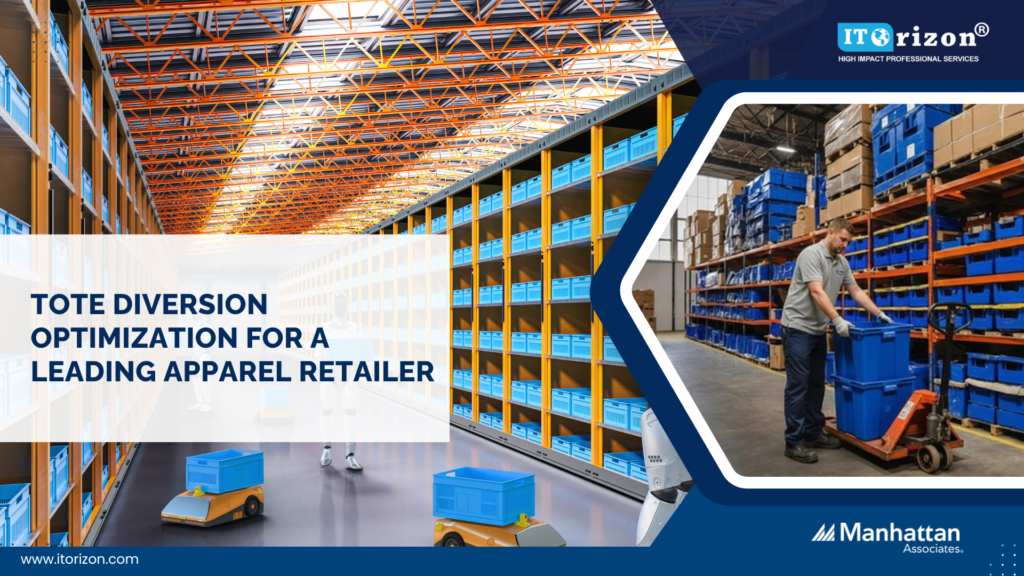
Tote Diversion Optimization for a Leading Apparel Retailer
How ITOrizon took tote diversion success from 0% to 100% by fixing WMOS and MHE messaging for a $650M apparel retailer
0→100%
Tote diversion success rate after deployment
$650M
Client revenue
2
MHE event messages required for successful diversion
Zero
Manual interventions after the fix
CLIENT SNAPSHOT
Business Overview
ITOrizon helped a major Apparel Retailer with $650 million in revenue solve a long-standing material handling issue in its Distribution Center. By optimizing the integration between the Manhattan WMOS platform and Material Handling Equipment (MHE), the client achieved a 100% tote diversion success rate.
CLIENT
Leading Apparel Retailer
LINE OF BUSINESS
Apparel retail
ANNUAL REVENUE
$650M
APPLICATIONS IN SCOPE
Manhattan WMOS, Material Handling Equipment (MHE)
FOCUS
WMS and MHE integration, conveyor tote diversion
Business Challenges
The client, which uses the WMOS platform, faced a critical issue with tote diversion failures occurring immediately after conveyor induction. The issue had plagued the operation since the project began and drove significant operational inefficiencies.
Key issues included
Tote Diversion Failures
Totes were constantly rejected and redirected to the jackpot location instead of their designated destination.
Manual Intervention
Extra labor hours were spent manually carrying rejected totes from the jackpot location to their intended destination.
Operational Delays
Manual handling delayed replenishment, which in turn delayed subsequent order fulfillment processes.
ITOrizon Solution
ITOrizon resolved a long-standing routing issue between the WMS and the MHE. The solution was differentiated by a targeted, rule-based approach tailored to the unique MHE messaging structure, and by deep system understanding and agility in WMOS configuration and MHE integration.
01
Deep Diagnosis
Initial troubleshooting revealed a failing MHE message within WMS, but rule adjustments alone did not stop the tote rejections. Deeper analysis showed that successful diversion required two distinct MHE event messages.
VALUE The true cause of the rejections found, rather than a partial fix.
02
Targeted Configuration
ITOrizon updated the message rules to accommodate both required MHE event messages.
VALUE Accurate communication between WMS and MHE.
03
Automated Flow Restoration
With both messages handled, tote diversion failures stopped and unnecessary jackpot routing ended.
VALUE Smooth, automated operations restored across the conveyor system.
Results delivered
The solution delivered immediate and complete success in the client’s DC.
0→100%
Tote diversion success rate rose from 0% before deployment to 100% after implementation.
ZERO
Manual interventions, with error rates significantly reduced.
100%
Of totes successfully diverted to their designated destinations.
LOWER
Labor hours and faster processing speed.
Results Delivered
| WHAT CHANGED | BEFORE | AFTER |
|---|---|---|
| Tote diversion | ×0% success rate, with totes rejected after conveyor induction | ✓100% success rate |
| Routing | ×Totes redirected to the jackpot location instead of their destination | ✓All totes diverted to their designated destinations |
| Manual handling | ×Labor hours spent carrying rejected totes from the jackpot to their destination | ✓Manual interventions eliminated and error rates significantly reduced |
| Fulfillment flow | ×Replenishment delays pushed back subsequent order fulfillment | ✓Reduced labor hours and improved processing speed |
KEEP EXPLORING
Related Case Studies

Seeing totes rejected at your conveyor?
If your WMS and material handling equipment aren’t routing totes the way they should, that’s the kind of integration issue we resolve.
- Tell us where totes are being rejected or rerouted today
- We’ll walk through how WMS and MHE messaging would be diagnosed
- No commitment, just a straight assessment