Thought Leadership
System of Record 2.0
The Next Evolution Beyond Systems of Record
Most organizations today are sitting on top of expensive, reliable foundational systems – their ERP, SCM, finance and operational platforms from vendors like SAP, Oracle, Microsoft, NetSuite, Kinaxis, Blue Yonder and others. Think of these systems as deep underground tunnels: they quietly and reliably record every official transaction, keep things auditable, ensure compliance and hold process integrity together. Because any disruption at this level can bring the whole business to a halt, these systems are built to be deliberately stable and resistant to change.
The problem is that once these systems go live, many enterprises stop thinking about transformation altogether. There’s an assumption that “going digital” was the finish line. So, when the expected business outcomes don’t show up, leadership often jumps to the wrong vendor, or that becoming truly intelligent means tearing everything out and starting over. That kind of thinking is what leads companies into expensive, high-risk transformation programs that often don’t deliver what was promised.
Understanding Transformation Maturity
There are really three distinct phases organizations go through, and most get stuck thinking phase 2 is the destination.
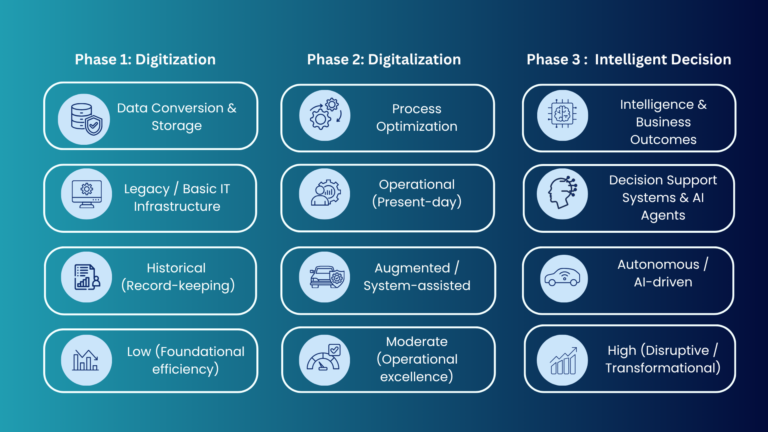
Phase 1 – Digitalization (The Foundational Era)
This is where analog information first becomes digital. The focus here is purely on creating historical records. The value delivered is administrative efficiency – but decisions still happen manually, disconnected from any real system intelligence.
Phase 2 – Digitalization (The Operational Era)
This is where enterprise platforms come in to standardize and automate processes. The docus shift to operational efficiency and scalability. Capabilities at this stage typically include workflow automation, transactional processing, and built-in reporting and dashboards.
Phase 3 – Intelligent Decision (The Decision Era)
This is the phase most companies haven’t reached, and it’s where real value lives. The shift here isn’t about replacing systems of record – it’s about layering an intelligence layer on top of them. This layer pulls together real-time and historical data, applies predictive analytics, generates recommendations, and enables controlled automation.
Rethinking the “Rip and Replace” Mindset
Large-scale system replacement projects are complex, costly, and risky – and often, replacing your core systems isn’t necessary to fix performance issues.
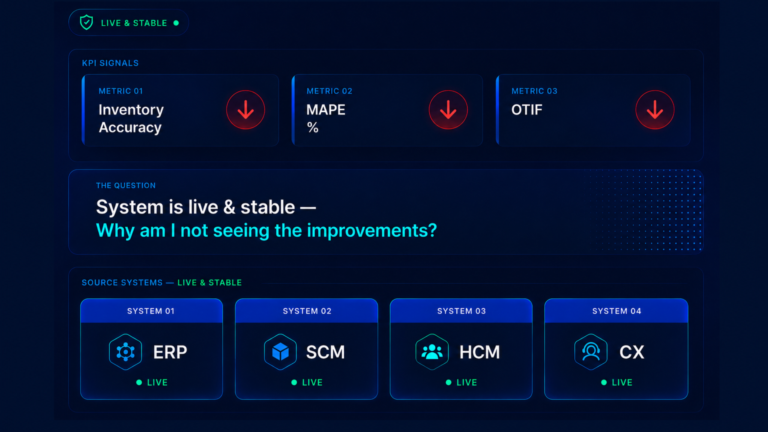
When the Gaps Are Still There
A familiar scenario: the system is live, it’s stable, everything’s running – but the expected improvements just aren’t showing up. Inventory accuracy is down, forecast error (MAPE) is up, on-time-in-full delivery is slipping. The question every leader ends up asking is the same: “The System works fine – so why aren’t we seeing the results we were promised?”.
“The real gap isn’t systems — it’s the missing Intelligent Decision Layer. Real-time data exists. What’s missing is the layer that surfaces the facts, the tradeoffs, and the right decision — before the window closes.”
The Smart Way Forward
Keep your core systems where they are. Build a solid data foundation around them. Then layer intelligence on top to drive better decisions – that’s really the whole idea in one sentence.
The smarter Approach: Build an Intelligence layer
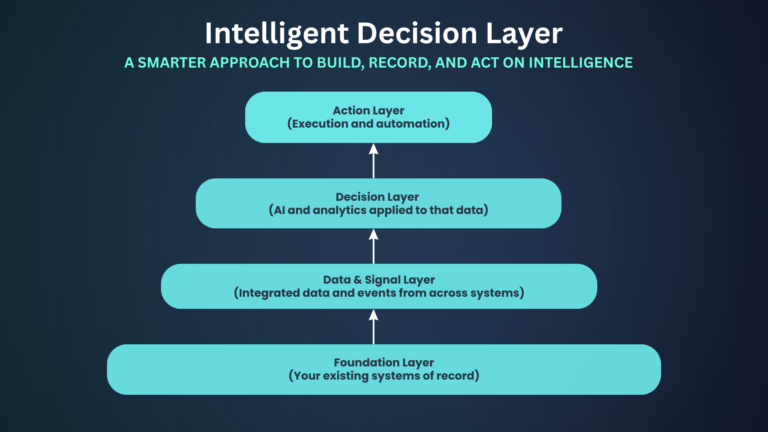
Instead of ripping things out, smarter organizations are taking a layered approach – keep the systems of record stable exactly as they are and build intelligence on top of them. This “System of Record 2.0” ingests data from across the business, applies analytics and AI to it, and helps people make better decisions faster.
How Value Builds Up, Layer by Layer
- Foundation Layer – Your existing systems of record
- Data & Signal Layer – Integrated data and events pulled from across systems
- Decision Layer – AI and analytics applied to that data
- Action Layer – Execution and automation based on those decisions
What This Actually Looks Like in Practice
The benefits are tangible – faster decision-making, better visibility across the business, and meaningfully improved forecasting. But none of this happens automatically. Success depends heavily on data quality, how well everything is integrated, and how well change is managed across the organization.
Why This Matters, depending on who you Are
- If you’re a CIO, this means you can extend the life and value of systems you’ve already invested in.
- If you’re a CFO, this gives you a way to target ROI you can measure.
- If you’re a CTO, this is your path to building intelligence platforms that stay flexible as the business changes.
Final Thought
The companies that win in the future won’t be the ones who ripped out the most systems – they’ll be the ones who figured out how to build intelligence on top of what already works. But getting there takes more than just technology. It takes the right partner.
Big consulting firms are great at strategy but often step back before execution – and that’s where outcomes get lost. Smaller firms move fast but usually lack the scale and depth to transform complex global operations.
What organizations really need is a right sized partner – one with both strategic clarity and hands-on execution experience, who knows exactly which levers to pull to deliver measurable impact. Whether that means optimizing the existing system of record or building toward a System of Record 2.0, the goal is the same: turning strategy into reality, end-to-end, at scale and with precision.
ITOrizon Inc., a global end-to-end IT supply chain ecosystem service leader based in Atlanta, with offshore locations in India and Dubai, has been helping clients ensure success for more than 10 years. We maximize the value of existing ecosystem investments while outpacing the competition with a human-first service delivery client experience. Industry analysts such as Gartner, ISG, and ARC Advisory have recognized us for our high-performance services team, built to scale and delivering strategic advisory, implementation/integration, digital transformation, and managed support services.