Thought Leadership
A Real-World View of WMi, WMOS, and the Active Migration
The Manhattan Crossroads
If you run a high-volume supply chain on Manhattan Associates software, you know the pressure to move to Manhattan Active Warehouse Management (MAWM) is constant. The marketing makes it sound like an absolute no-brainer: versionless code, automatic quarterly updates, and no more agonizing multi-million-dollar upgrade cycles.
But on the ground, sitting in the CIO or VP of Supply Chain chair, the choice is rarely that simple. The reality is that moving from a system you own—like WMi (the deeply trusted, iSeries-rooted workhorse) or WMOS (the J2EE Open Systems standard)—to an evergreen SaaS model changes your entire relationship with your data, your IT team, and your vendor.
Let’s skip the high-level consulting pitches and look at the actual operational friction, the hidden trade-offs, and the quiet doubts that supply chain leaders wrestle with when looking at this migration.
1. The Core Shift: Ownership vs. Configuration
Every single trade-off in this decision flows from one structural truth: With WMi and WMOS, you own and operate the stack. With Active, you subscribe to and configure it.
The Reality Check:
| Dimension | WMi (IBM i) | WMOS (Open Systems) | WM Active (MAWM) |
|---|---|---|---|
| Architecture | Monolith on IBM i | Monolith J2EE (SCPP) | Cloud-native microservices |
| Deployment | On-prem / hosted | On-prem / private / hosted | SaaS only (Google Cloud) |
| Upgrades | Manual, project-sized | Manual (functional freeze ~2020) | Versionless, continuous |
| Database Access | Full, direct SQL | Full, direct SQL | Restricted / abstracted |
| Customization | Source-code modifications | Code + configuration | Extension-only (APIs, webhooks) |
| Automation / WES | Bolt-on WCS/WES | Bolt-on WCS/WES | Embedded WES |
2. The Hardest Truth: What You Can't Take With You
When migrating to a SaaS architecture, “migrating customizations” is a myth. You don’t migrate them; you rebuild your business logic from scratch within a completely different paradigm.
The Hidden Losses
- Goodbye, Direct SQL: If your operation relies on hitting the database directly for ad-hoc queries, custom operational dashboards, or real-time data extraction, that ends with Active. You have to adapt to a governed data model via Supply Chain Intelligence (SCI).
- No More Base-Code Tweaks: In the legacy world, if a specific warehouse flow didn’t match your unique operational quirks, a developer could modify the core code. In Active, the core code is locked. You extend it via low-code tools, APIs, and webhooks, or you don’t do it at all.
- The Death of Triggers and Custom Tables: Database-level triggers and table-polling integrations—the glue holding many legacy ERP integrations together—must be completely decommissioned
The New Architecture Burden
Because you can’t touch the core database, your IT team now has to build and maintain an entirely new operational layer:
- An external, highly resilient event- and API-based integration layer.
- Webhook and user-exit handlers to execute custom business logic outside the WMS.
- The Quarterly Regression Harness: This is the most frequently underestimated cost of ownership in Active. While Manhattan pushes updates automatically every quarter, you are still responsible for testing your custom extensions, integrations, and material handling systems against the new code. Building a robust automated testing framework isn’t optional; it’s the price of staying evergreen.
3. The Legacy Dilemma: Autonomy vs. Decay
- Vendor-Spend Leverage: You aren’t tied to a single, recurring SaaS subscription. Your IT budget is spread across infrastructure hosting, database administrators, and specialized system integrators. You retain negotiating leverage.
- Total Troubleshooting Autonomy: When a distribution center grinds to a halt at 2:00 AM on a peak shipping day, a legacy architecture allows your internal team to dig directly into the logs and database tables. You don’t have to submit a high-priority ticket to a vendor queue and wait.
- Predictable, Owned Costs: If your legacy platform is stable and heavily customized to your exact physical layout, leaving it alone avoids massive capital expenditure and operational disruption.
The Decay Curve
The problem with legacy isn’t today; it’s tomorrow. The advantages of staying put tend to decay linearly, while the risks compound exponentially:
- Talent Scarcity: Finding engineers who truly understand RPG/iSeries for WMi, or the legacy J2EE framework of older WMOS versions, is becoming incredibly difficult—and expensive.
- The Innovation Gap: Modern warehouse efficiencies like advanced Order Streaming, native Warehouse Execution Systems (WES) for robotics, and built-in machine learning models cannot easily be bolted onto a legacy monolith.
- Security & Compliance: Patching aging operating systems, middleware, and out-of-date Java versions to satisfy modern cyber-insurance requirements is a growing operational headache.
4. Architectural Profiles: Where Does Your Operation Fit?
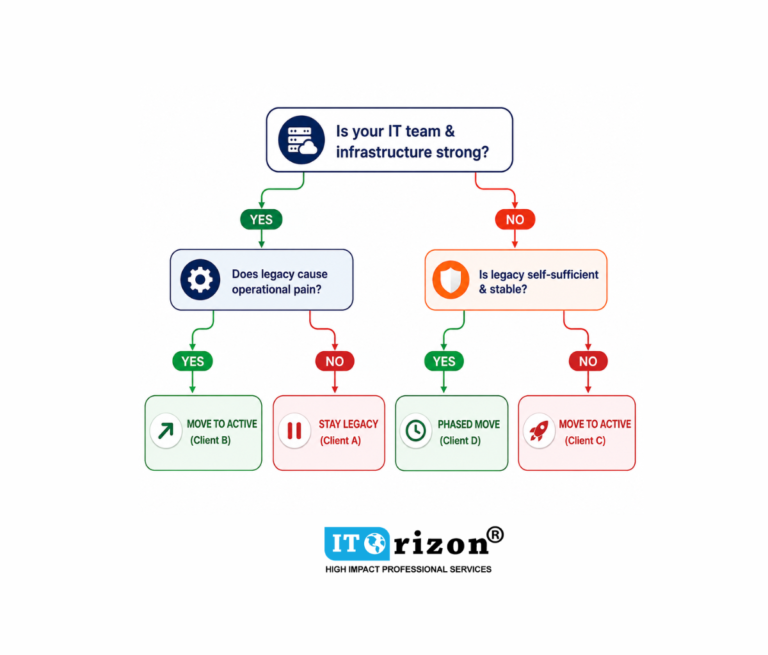
Every distribution ecosystem is distinct, but most companies weighing this decision fall into one of four distinct operational profiles.
Profile A: The Self-Sustained Monolith
- Characteristics: Strong internal IT infrastructure team, low vendor dependency, high operational stability, and minimal end-of-life (EOL) pressure.
- The Reality: This is the classic “if it ain’t broke, don’t fix it” scenario. If your legacy WMS meets your throughput requirements and your team completely owns the stack, the immediate ROI for an Active migration just isn’t there. Verdict: Stay Legacy.
Profile B: The High-Maintenance Performer
- Characteristics: High operational volume with a capable IT team, but plagued by custom code instability, constant version churn, and heavy overhead just to keep the lights on.
- The Reality: The issue here isn’t budget; it’s operational friction. A strong IT team will thrive under Active’s modern API/extension model, and moving to SaaS completely eliminates the crushing infrastructure maintenance burden that slows down business growth. Verdict: Move to Active.
Profile C: The Vulnerable Enterprise
- Characteristics: A lean, thin IT team running heavily modified legacy infrastructure with an impending EOL deadline and soaring third-party consulting spend.
- The Reality: This is an operational ticking time bomb. A lean team cannot adequately patch, secure, and manage legacy hardware long-term. Moving to Active consolidates your total cost of ownership into a single subscription and offloads the infrastructure risks to the vendor. Verdict: Move to Active.
Profile D: The Pragmatic Planner
- Characteristics: A lean IT team but highly self-sufficient operations; mid-level EOL exposure; stable but aging infrastructure.
- The Reality: You know you have to move eventually, but there is no immediate fire to put out. The best approach is to treat Active as a strategic destination, designing your upcoming enterprise integration layers to be cloud-ready so you can migrate on a business timeline rather than under software vendor duress. Verdict: Phased Move.
5. Balancing the Balance Sheet
Ultimately, the choice comes down to how you prefer to allocate capital and manage risk.
| Factor | Legacy (WMi / WMOS) DOCX | WM Active (MAWM) DOCX |
|---|---|---|
| Commercial Model | Owned, CapEx amortized | Subscription (OpEx) |
| Infrastructure | You operate it (Hardware, DBAs, OS) | Included in cloud subscription |
| Upgrades | Periodic, high-risk project-sized cycles | Continuous, quarterly zero-downtime validation |
| Customization | Free to write, but high long-term carrying cost | Built externally via governed extension points/APIs |
| Scaling | Provision and pay for peak capacity | Elastic, on-demand cloud scaling |
| Vendor Lock-in | Lower (multi-vendor leverage across SIs/hosting) | Higher (tied strictly to a single SaaS subscription) |
The Bottom Line
Stay with your legacy WMi or WMOS environment as long as its practical advantages pay you back and you can comfortably fund its long-term risks. But the moment those advantages are eaten up by talent scarcity, infrastructure instability, or rising support premiums, the scale tips.
Pressure-Testing Your Environment
Deciding if, when, and how to execute this shift requires a transparent look at your actual code footprint. ITOrizon provides a targeted, hands-on readiness assessment specifically designed to map out this transition. We dive straight into your legacy environment to audit your actual database triggers, custom code modifications, and third-party integrations, giving you a clear, objective picture of your migration complexity.
By acting as a deeply technical delivery partner, we work alongside Manhattan Services to ensure your operational realities, warehouse floor layouts, and custom extension logic are fully optimized for real-world execution.
Where does your operation sit on the legacy-to-active spectrum, and what is the single biggest technical roadblock holding back your migration strategy?
ITOrizon Inc., a global end-to-end IT supply chain ecosystem service leader based in Atlanta, with offshore locations in India and Dubai, has been helping clients ensure success for more than 10 years. We maximize the value of existing ecosystem investments while outpacing the competition with a human-first service delivery client experience. Industry analysts such as Gartner, ISG, and ARC Advisory have recognized us for our high-performance services team, built to scale and delivering strategic advisory, implementation/integration, digital transformation, and managed support services.