Thought Leadership
A Legacy Customer’s Guide to Manhattan Agent Foundry
Rethinking the AI Mandate
Every legacy Manhattan customer is currently staring down the same PowerPoint slide. It usually features a bold proclamation about agentic AI, a sleek workflow diagram, and a subtle but unmistakable subtext: Migrate to the cloud now, or get left behind.
At the center of this push is Manhattan Agent Foundry, a development layer designed to build and orchestrate AI agents natively within the Manhattan environment. For operations running on WMi (IBM iSeries) or WMOS (Warehouse Management for Open Systems), the marketing around Foundry creates an intense sense of urgency. But as someone who looks at these architectures from the system integrator’s perspective, I believe we need to inject some reality into the conversation.
Foundry is impressive software. But evaluating it in isolation is a mistake. It isn’t just an AI features suite; it is the tip of the spear for a massive, high-stakes cloud migration decision.
What Is Actually Real vs. What You Have to Build
If you strip away the keynote gloss, Agent Foundry is a configuration space. It lets business users use natural language and APIs to string together operational workflows without custom-code projects. Manhattan throws in a starter pack of about 20 pre-built agents—handling tasks like wave coordination, labor optimization, and shipment tracking.
The technology itself isn’t slideware. There are legitimate enterprise reference accounts running it in production. Giant Eagle uses a Wave Coordinator Agent to plan and release waves. Eaton uses the stock wave and labor agents alongside a custom-built “Dock Agent” to manage workflow bottlenecks.
Internally, Manhattan has engineered a sensible governance framework. They call it human-guided autonomy. The agents operate within strict guardrails and escalate anomalies to human operators. In a live distribution center, where an unguided AI cascade could misroute thousands of orders and freeze operations in minutes, this bounded autonomy is the only acceptable posture.
Here is the internal question you have to ask yourself, though: Are twenty out-of-the-box agents going to run our highly customized distribution network?
Probably not. Every enterprise supply chain has unique exceptions, legacy logic, and physical quirks. Manhattan openly expects you to build your own custom agents to bridge these gaps. While Foundry lowers the technical barrier to building an agent, it does not eliminate the operational burden of defining, testing, and governing it. The capability works, but the realization of its value is entirely dependent on your team’s—or your SI’s—capacity to manage the build burden.
The Central Catch: The Cloud Gate
For a WMi or WMOS user, the most critical piece of data isn’t what the agents can do. It’s where they live. Agent Foundry is an ActivePlatform capability. It will not run on your on-premises legacy architecture.
Manhattan’s roadmap is clear: the path to AI requires a full platform replacement. You cannot bolt Foundry onto a legacy instance. Accessing it requires migrating to Manhattan Active WM, which means re-platforming every configuration, integration, MHE layout, and business process across your distribution centers.
This creates a serious risk of sequencing inversion—letting AI FOMO (Fear of Missing Out) push your organization into a rushed, vendor-paced cloud migration before you’ve completed the foundational readiness work.
Consider the current state of many legacy environments. WMOS had its final release years ago (2020 Q2). While these systems are highly stable, run predictably on midrange hardware, and continue to execute daily volumes reliably, they are functionally static. A rushed leap into Active WM just to access AI agents introduces massive operational risk. The AI must be the destination, not the justification for a hurried migration.
Evaluating the Hidden Tradeoffs
Before jumping into a pilot, an enterprise team needs to weigh several unpolished realities:
- The Build and Governance Burden: A tool that makes agent creation “no-code” can inadvertently lead to sprawl. Who governs the agents? Who audits an agent’s logic when it makes an sub-optimal inventory allocation? If you budget solely for the software transition and under-budget for the engineering talent required to maintain these workflows, the project will underperform.
- Immature Consumption Economics: Manhattan is utilizing low-risk 90-day pilots to ease adoption. However, long-term monetization relies on post-pilot subscription conversions and consumption-based usage. Predicting your exact run-rate costs under a consumption model before going live is highly complex, leaving early adopters to absorb substantial pricing uncertainty.
- Google Shop: Manhattan Agent Foundry runs natively on Manhattan’s Active Platform and is built using Google technologies, including Google Agentspace and Vertex AI. As organizations adopt Foundry-based AI workflows, they may increase their dependence on Google’s AI ecosystem and services. While Manhattan supports interoperability standards such as A2A and MCP, deeper adoption could make future multi-cloud AI strategy changes more complex and costly.
A Disciplined Sequencing Blueprint
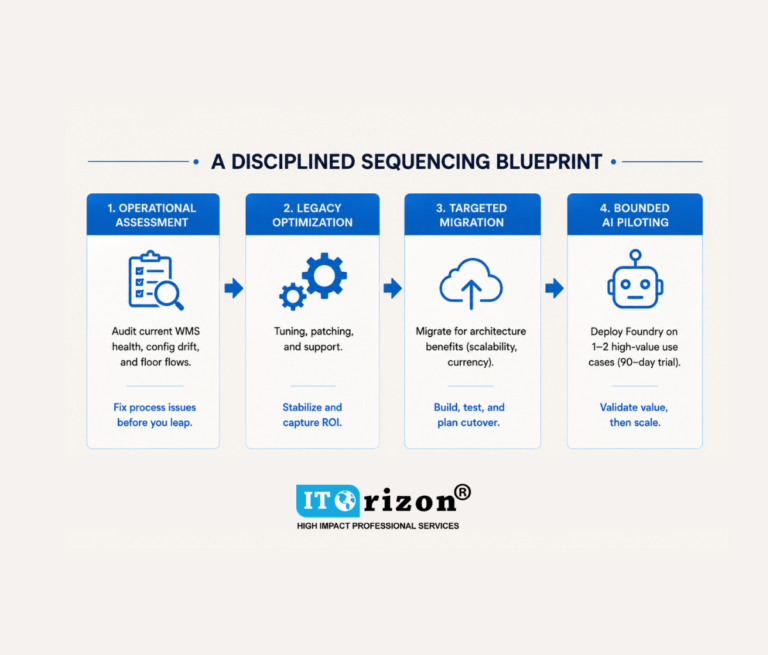
So, how should an enterprise operations team approach this? The answer is disciplined sequencing rather than rushed execution. You can decouple the decision to modernize your architecture from the decision to adopt AI.
| Phase | Strategic Action | Focus Area |
|---|---|---|
| 1. Operational Assessment | Perform an independent audit of current WMS health, configuration drift, and physical floor flows. | Identify if your problems require process fixes or advanced AI. |
| 2. Legacy Optimization | Maximize the value of existing WMi/WMOS platforms through database tuning, patch updates, and support. | Stabilize performance and capture ROI without immediate cloud migration. |
| 3. Targeted Migration | Scope a multi-DC cloud migration strictly around architectural benefits (scalability, currency). | Build thorough testing environments and cutover playbooks. |
| 4. Bounded AI Piloting | Deploy Foundry against one or two isolated, high-value use cases using a 90-day trial. | Validate the financial case before committing to a broad rollout. |
Ground-Truth Questions for Your Next Review
Before signing off on a modernization strategy, place these hard questions on the table for your vendor and system integrator:
- Migration Integrity: How much of our specific integration logic (MHE, WCS, TMS) can be ported over automatically, and what must be built from scratch for Active WM?
- Auditability and Fallbacks: If a wave-critical agent behaves unpredictably during a peak season volume spike, what is the precise operational rollback procedure?
True Cost of Ownership: What are the projected consumption costs at our peak transaction volumes, and how will our internal teams manage custom agent maintenance long-term?
The Takeaway
Manhattan Agent Foundry represents an excellent, well-architected framework for supply chain execution. The organizations that succeed with Foundry will be those that modernize their infrastructure based on sound operational fundamentals, adopting agentic workflows deliberately and at their own pace—not on the vendor’s release calendar.
ITOrizon Inc., a global end-to-end IT supply chain ecosystem service leader based in Atlanta, with offshore locations in India and Dubai, has been helping clients ensure success for more than 10 years. We maximize the value of existing ecosystem investments while outpacing the competition with a human-first service delivery client experience. Industry analysts such as Gartner, ISG, and ARC Advisory have recognized us for our high-performance services team, built to scale and delivering strategic advisory, implementation/integration, digital transformation, and managed support services.