Thought Leadership
From ERP to ERX: Why the Next Generation of Enterprise Systems Is Autonomous
Turn warehouse data into enterprise intelligence
For more than three decades, ERP has been the operational backbone of the enterprise for consolidating financials, operations, and HR into a single source of truth, mostly by looking backward at what already happened. That era is ending. ERP is undergoing a fundamental architectural shift, taking on the ability to sense, decide, and act in real time rather than simply log events after the fact.
This next stage is being called ERX – Enterprise Resource Execution, the “X” stands for process execution, extensibility, experience, and extended intelligence.
Why ERX, and Why Now
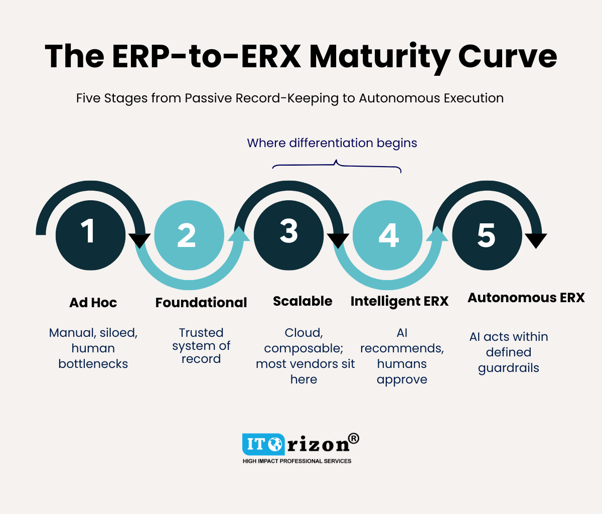
The pace of market disruption, supply chain volatility, and competitive change has outgrown the ability of human-mediated systems to keep up. Organizations sit along a five-stage maturity curve
- Ad hoc
- Foundational
- Scalable
- Intelligent, and
- Autonomous
and most enterprises today are still stuck at the scalable stage: modernized enough to see AI’s potential but not yet architected to use it. The gap between scalable ERP and intelligent ERX is where competitive differentiation will be won or lost.
Organizations that delay cloud migration, clean-core discipline, or data integration risk becoming architecturally excluded from the next era of enterprise software, not just functionally behind.
Characteristics that Define ERX
ERX is distinguished from traditional ERP by six characteristics that evolve at different rates:
- Adaptive Experience (dynamic, persona-driven UX)
- Autonomous Orchestration (AI-driven workflow execution)
- Composable Architecture (modular, interchangeable services)
- Connected Data (a unified data fabric across the enterprise)
- Fluid Knowledge (structured and unstructured information flowing freely between systems and people)
- Embedded Insights (analytics built into the workflow rather than bolted on)
Together, these six pillars determine how far an organization has actually moved from passive record-keeping toward active, intelligent execution.
Source: Gartner
Business Outcome
Gartner’s own strategic planning assumption puts a hard number on this shift “By 2030, over 50% of foundational ERP tasks will be autonomously executed by AI” — reducing manual involvement in finance, supply chain, and HR. The payoff isn’t incremental efficiency, it’s category change. Organizations that reach ERX won’t just operate better than competitors; they’ll compete in a different category altogether, turning what was once a cost center into a source of speed, agility, and durable advantage.
Two Paths to ERX, Not One
ERX won’t look the same for every organization, because the underlying nature of work differs by business model.
- Product-centric enterprises run on highly structured, deterministic processes bills of materials, inventory states, revenue recognition rules; where AI agents can execute against well-defined logic with high confidence.
- Service-centric organizations operate on more unstructured inputs: client engagements, judgment calls, and tacit expertise that resist tidy schemas. For these businesses, ERX must lean more heavily on retrieval, interpretation, and human-in-the-loop reasoning rather than straight-through automation. A vendor pitching one-size-fits-all ERX is, by definition, only solving for one half of the market.
This is also why buyers should be skeptical of vendor messaging today. Many vendors are currently selling an ERX vision while delivering foundational or scalable ERP capabilities. Evaluating roadmaps not just demos, will be essential to separate real progress from marketing.
ERP vs ERX: The Core Difference
| Category | Traditional ERP | ERX |
|---|---|---|
| Nature | System of record | System of continuous execution |
| Function | Tracks past events | Orchestrates real-time, future actions |
| Structure | Rigid, monolithic, siloed | Composable, event-driven mesh |
| Pace | Human-mediated, periodic | AI-driven, near-zero-latency |
The underlying shift is one of posture: ERP stops waiting to be told what happened and starts deciding what happens next.
The Takeaway
None of this means ERP is being replaced, it means the bar for what counts as “modern ERP” is moving. Most organizations aren’t behind because they lack ambition; they’re behind because the path from where they sit today to genuine ERX is rarely a straight line, and it looks different depending on whether your business runs on structured process or human judgment.
That’s the conversation worth having early: not which vendor has the best AI demo, but where your organization sits on the maturity curve, and what a realistic, sequenced roadmap to ERX looks like for your specific business model. That assessment is to be done honestly, before any platform decision gets made; is where the real groundwork for ERX begins.
ITOrizon Inc., a global end-to-end IT supply chain ecosystem service leader based in Atlanta, with offshore locations in India and Dubai, has been helping clients ensure success for more than 10 years. We maximize the value of existing ecosystem investments while outpacing the competition with a human-first service delivery client experience. Industry analysts such as Gartner, ISG, and ARC Advisory have recognized us for our high-performance services team, built to scale and delivering strategic advisory, implementation/integration, digital transformation, and managed support services.