Thought Leadership
From Manhattan Active to AI Agent Foundry: Get Started
Things to Consider
Most Manhattan Active customers have heard the pitch by now: describe what you need in plain language, connect to platform APIs, and let agents handle workflows across your distribution network.
It Sounds effortless, doesn’t it? But if you run a warehouse floor, you know the real question isn’t whether the builder tool works—it’s what you would actually trust an agent to touch.
Manhattan Agent Foundry isn’t an interactive chat assistant or an automated reporting dashboard. Manhattan designed it as an execution framework where agents can evaluate live data, follow structured operational logic, call platform APIs, and operate within defined guardrails.
Did you know?
Insight Is Just the Beginning. Action Is Where AI Creates Value.
Move from simply understanding operational bottlenecks to actively resolving them with intelligent agents that can help drive the work forward.
Clearing Up the Terms: Foundry vs. Active Agents
It is easy to mix up the development environment with the workers themselves:
Agent Foundry
It is the workshop. It’s the configuration layer where you create, modify, and govern agents.
Manhattan Active Agents
The pre-built, out-of-the-box agents Manhattan ships, around twenty baseline workers focused on common wave, labor, and shipment tracking tasks.
Custom Agents
What you build yourself when your operational rules don’t match a standard template.
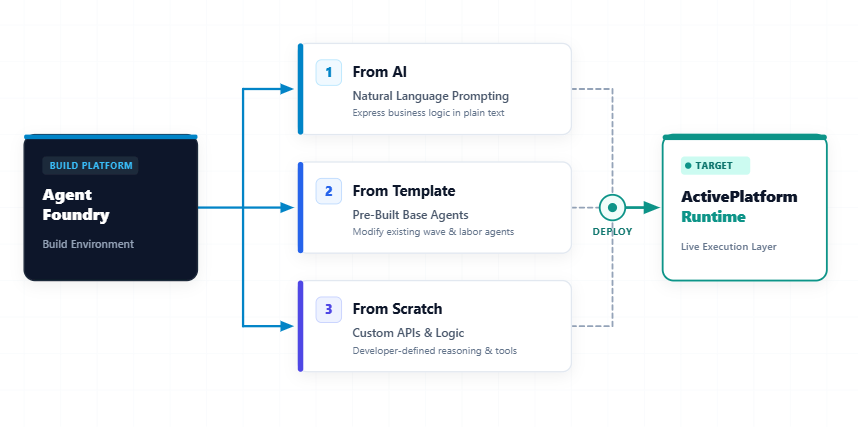
Three ways to build
Manhattan provides three ways to build: describe what you want in natural language, modify an existing base agent template, or build the logic, API calls, and decision flows from scratch.
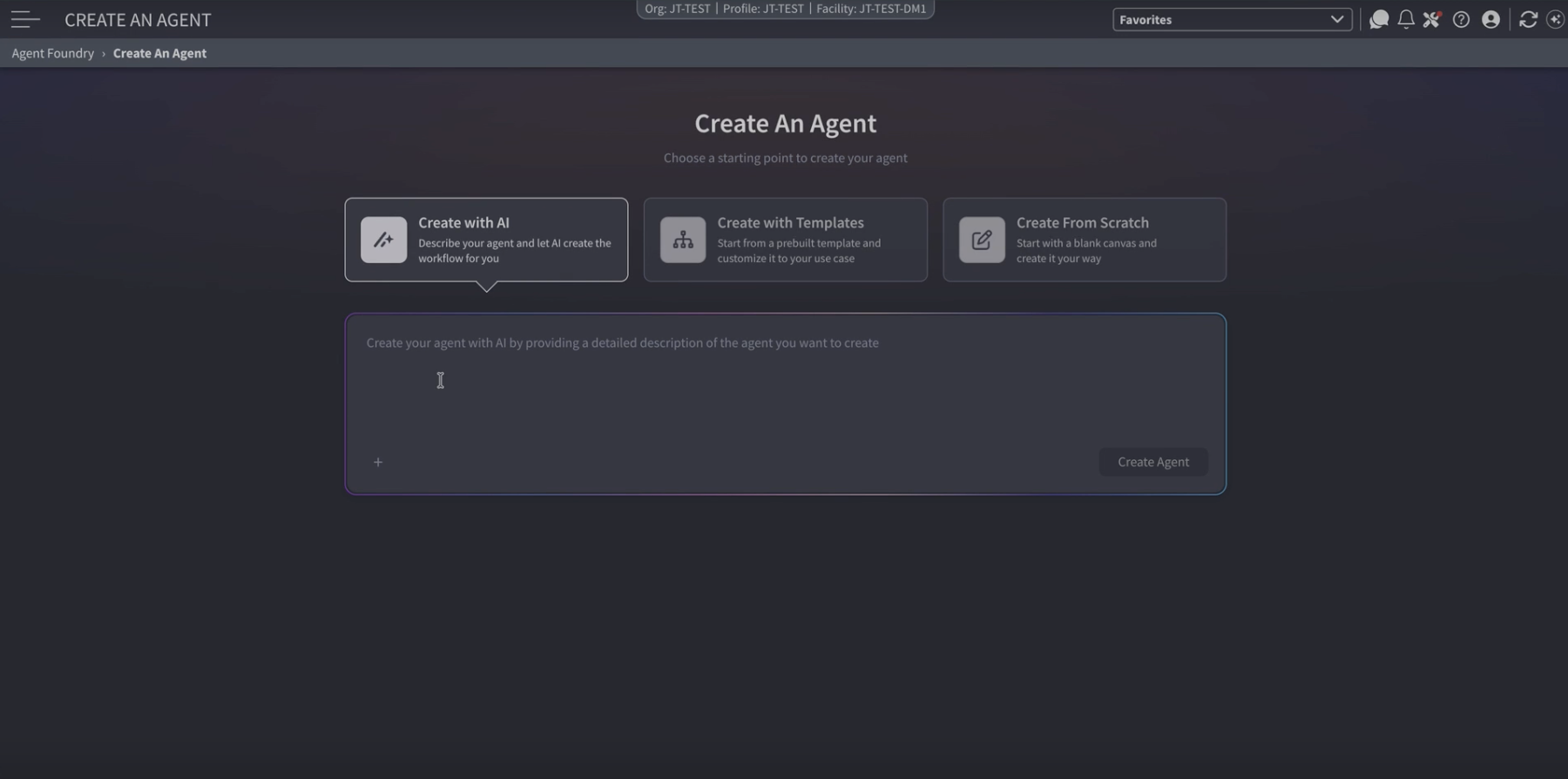
What an Agent Actually Does on the Floor
Instead of thinking in technical abstractions like LLMs and API calls, look at what an agent does during a live shift:
Observe
Monitors wave progress, shorted lines, pending tasks, or carrier status.
Reason
Evaluates multiple operational signals to determine the underlying cause of an issue.
Decide
Determines a recommended action based on defined business rules and current context.
Act
Calls approved APIs to trigger workflows or update records.
Escalate
Stops and routes the decision to a supervisor whenever an exception falls outside its boundaries.
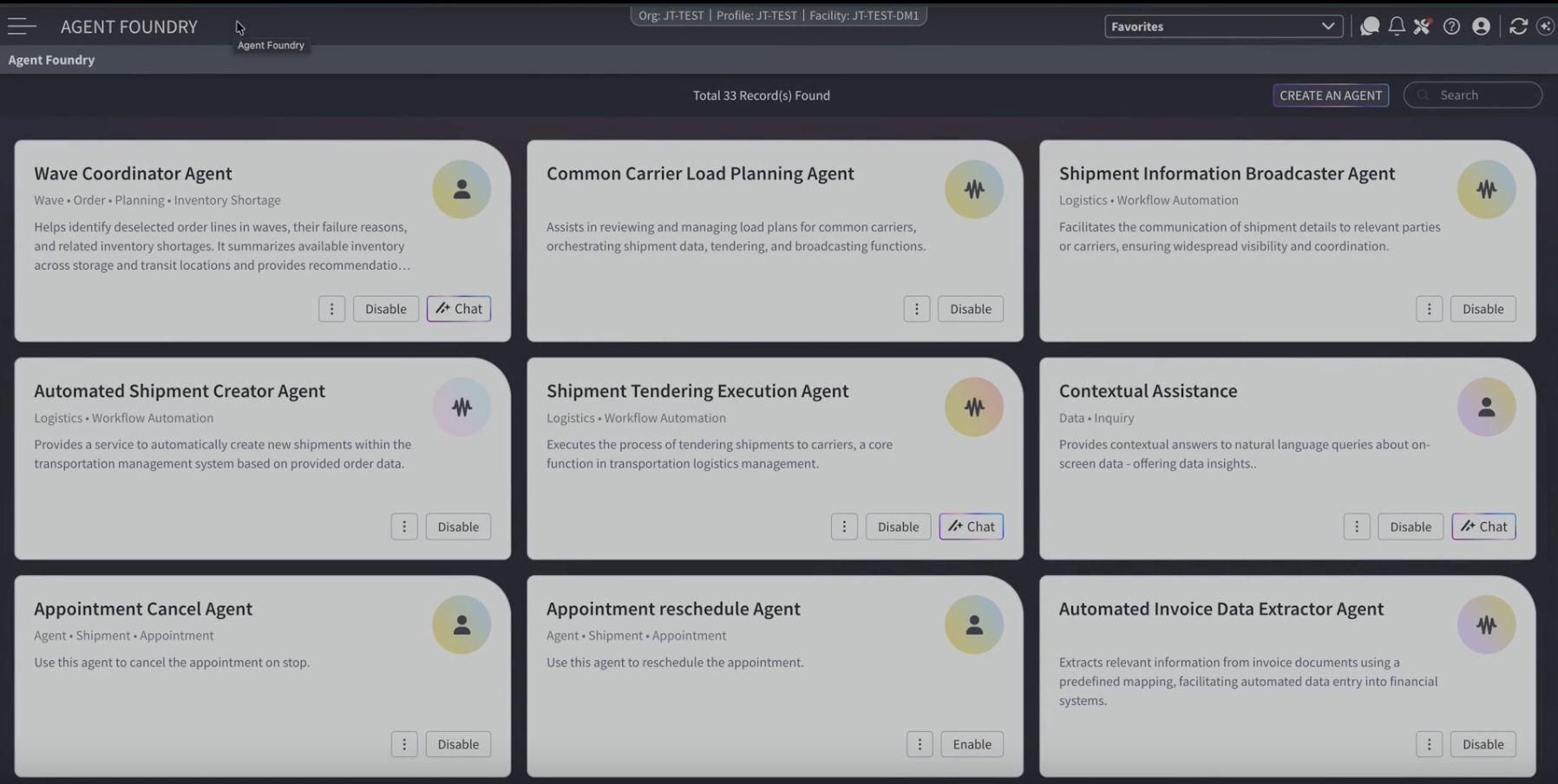
Six Warehouse Scenarios: Out-of-the-Box vs. Custom Builds
It helps to separate what Manhattan provides today from what you could build custom using Foundry. Select a scenario:
Wave Exception Investigation
Dynamic Labor Guidance
Shipment Risk Monitoring
Unfulfillable Inventory Triage
Site-Specific SOP Execution
Floor Diagnostics Assistant
Wave Exception Investigation
The Problem: A planned wave fails to release on schedule.
The Application: Manhattan already highlights capabilities like its Wave Inventory Research Agent. Instead of an operator checking multiple screens, the agent investigates the underlying constraints, flags the likely conflict, and recommends a specific corrective step to release the wave.
Dynamic Labor Guidance
The Problem: Inbound volume surges unexpectedly while packing lines slow down.
The Application: Using Manhattan’s base Labor Agent, the system tracks remaining work against standard rates and provides shift leads with guidance on where to reassign associates across departments to clear the bottleneck.
Shipment Risk Monitoring
The Problem: A shipment is at risk of missing its carrier cutoff window.
The Application: Manhattan’s out-of-the-box shipment tracking capability monitors milestones, flags delays early, and alerts dispatchers to take compensating actions.
Unfulfillable Inventory Triage
The Problem: Inventory shows as available in the system, but an order stalls during fulfillment.
The Potential Build: You could construct an investigation agent in Foundry that cross-references location holds, lot status, and active allocation locks, pinpointing the specific constraint for an inventory analyst.
Site-Specific SOP Execution
The Problem: Your operation has unique handling rules—such as specialized packaging for VIP accounts or strict sequencing for perishable goods.
The Potential Build: This is where custom Foundry agents make sense. Rather than waiting for a core product change, you can build an agent that evaluates your unique business rules and flags exceptions directly at order release.
Floor Diagnostics Assistant
The Problem: A supervisor needs to know why throughput dropped in a specific zone.
The Application: An interactive agent investigates recent operational data, labor allocation, and equipment error logs, returning a clear explanation instead of forcing a supervisor to dig through multiple disconnected screens.
Guardrails
The Hard Part Isn't Building, It’s Setting Boundaries
The development cycle inside Foundry lets you define a problem, connect tools, set rules, test, and deploy. Manhattan gives both business users and developers tools to do this.
Building the agent is rarely where projects get stuck. The real challenge is deciding exactly what an agent should be permitted to do.
When should an agent only recommend an action, and when should it be allowed to execute via API? Where does supervisor approval become mandatory? Setting those procedural guardrails requires practical warehouse experience, not just software expertise.
Step 1
A Simple Filter for Starting Out
Don’t start by trying to automate an entire department on day one. Pick a single operational problem that passes three tests:
- High Frequency: It happens multiple times every shift.
- High Friction: Supervisors spend 15 to 20 minutes manually digging through data to resolve it.
- Controlled Risk: It has clear, predictable boundaries where an initial recommendation-only model adds value without risking line shutdowns.
Step 2
Solve the Data Puzzle
Agent Foundry can invoke Manhattan Active APIs, third-party endpoints, and collaborate with external agents using protocols like MCP and Agent-to-Agent (A2A).
Before building, ask a practical question: Where does the context required to make this decision actually live?
If all the required data lives inside Manhattan Active, things remain relatively straightforward. But if an agent needs real-time context from an ERP, an external TMS, a WCS/WES, or carrier feeds, your scope expands. The agent’s recommendations are only as reliable as the speed and consistency of those external integrations.
Step 3
Change Management
Most organizations will move through four distinct phases:
- Assist: Agents answer operational questions and locate data quickly.
- Recommend: Agents analyze patterns and present recommended actions for human sign-off.
- Execute: Agents carry out routine, low-risk actions through approved workflows.
- Collaborate: Multiple agents coordinate across labor, inventory, and transport.
For Manhattan Active customers, Agent Foundry provides the tools to build that automation. But while building an agent is more accessible than ever, defining the operational boundaries, wiring up the right data, and measuring the outcome still takes experienced warehouse judgment. That operational foundation is what makes the technology actually deliver on the floor.
Ask ITOrizon AI Team