Thought Leadership
A Practical Guide to Oracle Demand Planning Cloud for Better Forecasting
Turn warehouse data into enterprise intelligence
Why Businesses Can’t Afford to Guess Demand Anymore
Ever walked into a store and found your size missing? Or noticed shelves packed with products no one seems to want?
That is not random. It is what happens when businesses try to guess demand instead of planning for it.
For a long time, companies have operated in reactive mode. Something sells out, they rush to restock. Inventory piles up, they scramble to clear it. By the time they act, the damage is already done.
This is exactly the problem demand planning is meant to solve.
What Demand Planning Really Means
At its core, demand planning is about forecasting future demand so businesses can prepare in advance.
Instead of reacting to what already happened, companies try to understand what is likely to happen next. This helps them align inventory, production, and supply chain decisions with expected sales.
Demand planning platforms are designed to support this shift. They bring together data, forecasting models, and planning tools so businesses can move from guesswork to informed decisions.
Ready to Unlock the Full Potential of Oracle Demand Planning?
From cloud assessment to seamless integration, our Oracle consultants support your end-to-end planning journey. Improve forecast accuracy, streamline operations, and reduce inventory and cost.
From Reactive to Proactive: The Real Shift
The biggest value of demand planning is not just better forecasts. It is a complete change in mindset.
In a reactive approach:
- Teams respond after problems occur
- Stockouts and overstocks are common
- Decisions rely heavily on intuition
In a proactive approach:
- Teams anticipate demand ahead of time
- Inventory is better aligned with actual needs
- Decisions are backed by data and analysis
Instead of constantly putting out fires, businesses start preventing them.
Why This Matters More Than Ever
When demand is forecasted accurately, you are more likely to have the right product available when customers want it. That means fewer lost sales and better customer satisfaction.
It also helps reduce excess inventory. Less money is tied up in unsold goods, and there is less waste across the supply chain.
On top of that, clearer visibility into future demand supports better financial planning. Businesses can budget with more confidence and reduce the risks that come with uncertainty.
What Oracle Demand Planning Actually Does
Oracle Demand Planning is built to handle the complexity of forecasting in real-world business environments. Instead of relying on static spreadsheets or one-size-fits-all models, it combines data, analytics, and flexibility to support more informed planning.
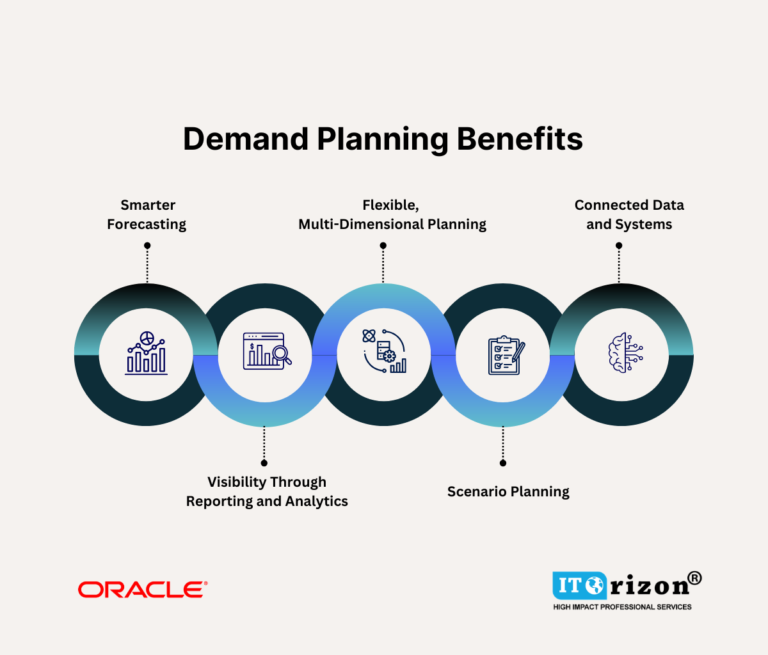
Smarter Forecasting
- Oracle Demand Planning uses a mix of statistical techniques and AI-driven models to generate forecasts. It can identify unusual patterns, filter out anomalies, and automatically choose the most suitable forecasting method.
Flexible, Multi-Dimensional Planning
- Demand rarely exists in a single dimension. Businesses need to plan across products, regions, channels, customer segments, and time periods.
- Oracle allows planners to view demand at an aggregated level or drill down into details. This makes it easier to understand trends and adjust plans where needed.
Event and Lifecycle Awareness
- Demand is often shaped by external and internal events. Product launches, promotions, seasonal trends, and phaseouts all influence how products perform.
- Oracle Demand Planning includes capabilities to model these factors, allowing forecasts to reflect real-world conditions instead of just historical patterns.
Connected Data and Systems
- Accurate planning depends on having the right data in one place.
- Oracle integrates with ERP, SCM, and other enterprise systems to bring together data from multiple sources. It also supports data collection, cleansing, and regular updates, helping maintain consistency and reliability.
Visibility Through Reporting and Analytics
- Planners need clear visibility into how forecasts are performing.
- Oracle provides dashboards, alerts, and performance metrics that highlight forecast accuracy, bias, and exceptions. This allows teams to quickly identify issues and take corrective action.
Scenario Planning
- One of the practical strengths of Oracle Demand Planning is the ability to test different scenarios.
- Planners can simulate demand spikes, supply disruptions, or changes in pricing and promotions. This helps evaluate potential risks and make adjustments before decisions are finalized.
Feeding the Broader Supply Chain
- Demand planning does not operate in isolation. The forecasts generated in Oracle serve as inputs for downstream processes like inventory optimization and supply planning. This ensures that the broader supply chain is aligned with expected demand.
How This Plays Out in the Real World
Fashion Retail
Fashion retailers deal with a huge variety of products. Different sizes, colors, and styles need to be distributed across locations. Deciding what to stock where can quickly turn into a guessing game. Demand planning changes that by using historical data and forecasting models to guide decisions. Instead of relying on intuition, retailers can allocate inventory more strategically.Grocery Chains
For grocery businesses, the stakes are different but just as high. Stock too much, and products expire. Stock too little, and customers walk away empty-handed. Demand is influenced by promotions, holidays, and seasonal patterns, which makes forecasting more complex. Demand planning systems can factor in these elements, often using causal inputs like promotions or events, to create more accurate forecasts.Challenges You Should Not Ignore
Even with the right tools, demand planning is not automatically successful. One of the biggest hurdles is data quality. Incomplete or inconsistent data can undermine forecasts and reduce trust in the system.
There is also a human factor. Moving away from spreadsheets to a structured planning system requires training, new processes, and a shift in mindset. Process design plays a major role as well. Without clear ownership, planning cycles, and defined metrics, even the best tools can fall short.
Integration can also be complex. Connecting multiple systems and aligning product or customer hierarchies takes effort and careful planning. Recognizing these challenges early makes it easier to address them effectively.
Final Thoughts
Demand planning has become a critical capability for businesses that want to stay ahead of uncertainty rather than react to it.
Oracle Demand Planning plays a role in enabling this shift by bringing together forecasting, data, and scenario analysis into a single, structured process. Instead of relying on disconnected tools or manual assumptions, it provides a more consistent way to plan, review, and adjust demand.
That said, the value does not come from the tool alone. It depends on how well organizations define their planning processes, maintain data quality, and align teams around a shared view of demand.
ITOrizon Inc., a global end-to-end IT supply chain ecosystem service leader based in Atlanta, with offshore locations in India and Dubai, has been helping clients ensure success for more than 10 years. We maximize the value of existing ecosystem investments while outpacing the competition with a human-first service delivery client experience. Industry analysts such as Gartner, ISG, and ARC Advisory have recognized us for our high-performance services team, built to scale and delivering strategic advisory, implementation/integration, digital transformation, and managed support services.