ITOrizon – An Early Adopter of Oracle Integration Cloud Services
How a hybrid integration platform built on Oracle Integration Cloud replaced manual batch processing with real-time integration for a manufacturing and distribution customer
~90%
Reduction in overall integration build time
4
Integration types: orders, POs, shipments, ASNs
Real-time
Replacing manual batch processing
CLIENT SNAPSHOT
Executive Summary
As more and more organizations become focused on a cloud-first strategy, they often face business and technical challenges. To overcome them, Gartner recommends a Hybrid Integration Platform (HIP) instead of a task specific integration toolkit, which helps with increased business agility, lower compliance cost, and rapid innovation.
CLIENT
Manufacturing & Distribution Customer
LINE OF BUSINESS
Distribution
PROJECT LOCATION
Saudi Arabia (Market: UAE)
APPLICATIONS IN SCOPE
Oracle WMS, OTM, GTM, OIC
ERP SYSTEM
Oracle ERP
Business Challenges
Cloud-first strategies bring business and technical challenges, and ITOrizon faced several more at the initial stage of the implementation.
Key issues included
Business Challenges
Slow adoption, obscure experiences, manual processes, and data silos.
Technical Challenges
Connecting cloud, on-premises or hybrid applications, process automation, consolidated end-to-end visibility, unified API design, security, and management.
Lack of Real-Time Integration
Applications could not exchange critical data in real time.
Data Model Differences
Differing data models across the connected applications.
Business Process Differences
Differing business processes across the connected applications.
Customizations and Existing Extensions
Existing customizations and extensions had to be accommodated.
Case in Point: Manufacturing & Distribution Customer
ITOrizon implemented Oracle Warehouse Management Cloud and Oracle Integration Cloud Service for WMS integrations with Oracle’s NetSuite applications for this manufacturing services-based customer. Several integrations included Sales Order, Purchase Orders, Inbound Shipments, and Advanced Shipment notifications.
01
Hybrid Integration Platform with OIC
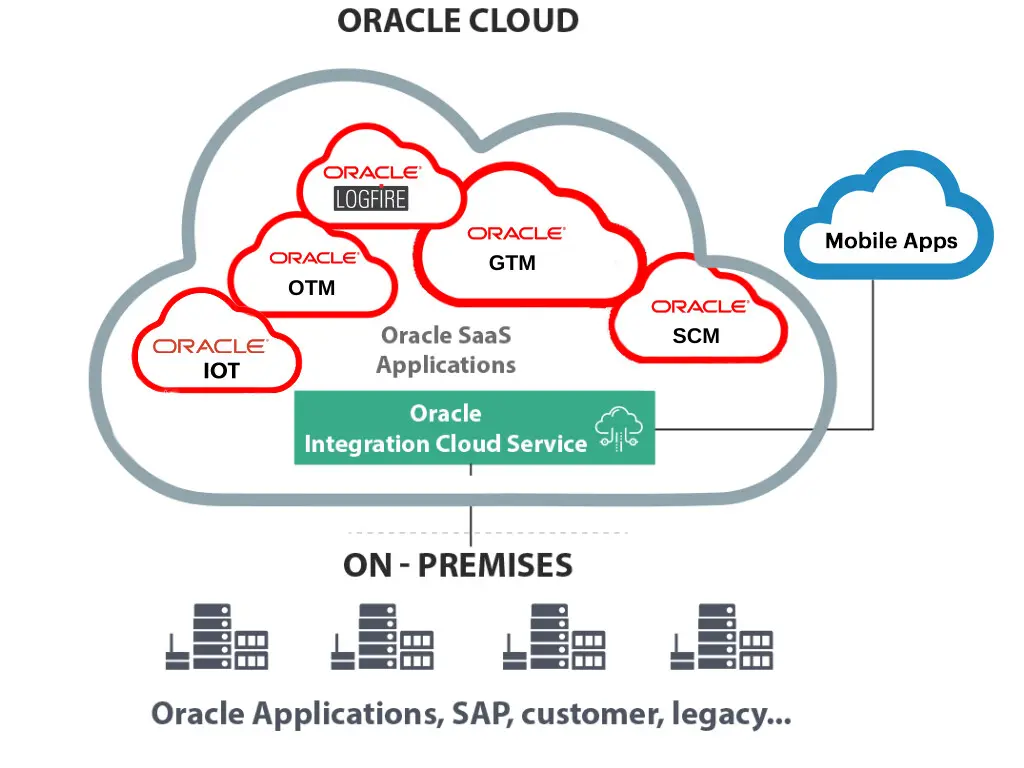
Oracle Integration Cloud services (OIC) as the Hybrid Integration Platform supports various integration domains (application, data, process), full deployment flexibility (cloud, on-premises, hybrid), and various end points (mobile, IoT, chatbots).
VALUE Simplified integration with pre-built adapters and integration flows.
02
NetSuite to Cloud WMS Integration
NetSuite was integrated into Cloud WMS using OIC, and NetSuite’s Sync Bundle was used for data mapping and translations.
VALUE Real-time connection of multiple enterprise applications instead of manual batch processing.
03
PaceJet and True Commerce Integrations
The architecture also included external applications like PaceJet (Rate Shopping Software) and True Commerce (uses EDI connected consumers), with customizations of NetSuite and LogFire (Cloud WMS). OIC integration connected PaceJet with Cloud WMS.
VALUE Automated orders, shipments, and invoice data integration, resulting in faster order fulfillment.
04
Auto Mapping and Translation Services
OIC provides auto mapping and translation services across apps, with a standards-based infrastructure that ensures interoperability among all types of applications.
VALUE Simplified development, activation, and management.
05
Best Practices from the Implementation
Use a canonical model for definitions or simplified mappings to target systems, develop common fault handling patterns in all integrations, and develop standard reusable services wherever possible to integrate with external systems.
Results delivered
ITOrizon has developed technical capabilities and vast experience implementing OIC solutions across multiple applications, and is one of the preferred system integrators for customers on their journey to Oracle Cloud.
~90%
Reduction in overall processing time for building integrations between cloud-to-cloud and cloud to on-premise applications.
REAL-TIME
Multiple enterprise applications connected in real time versus manual batch processing.
FEWER ERRORS
Significant reduction in errors and enhanced visibility reporting.
FASTER
Significant growth in overall business processing from automated orders, shipments, and invoice data integration, resulting in faster order fulfillment.
Results Delivered
| WHAT CHANGED | BEFORE | AFTER |
|---|---|---|
| Integration approach | ×On-premise integrations | ✓Integration Cloud, delivering efficiency gain, business process transformation, and cost-saving |
| Processing | ×Manual batch processing | ✓Multiple enterprise applications connected in real time |
| Errors and visibility | ×Manual processes and data silos | ✓Significant reduction in errors and enhanced visibility reporting |
| Order fulfillment | ×Manual handling of orders, shipments and invoices | ✓Automated orders, shipments, and invoice data integration, with faster order fulfillment |
| Integration build time | ×Task specific integration toolkit | ✓Almost 90% reduction in overall processing time for building integrations |
KEEP EXPLORING
Related Case Studies


Ready to integrate your Oracle Cloud and third-party applications?
If manual batch processes and data silos are slowing your business down, that’s exactly the kind of integration work we do.
- Tell us which applications you need to connect
- We’ll walk through what an Oracle Integration Cloud approach would take
- No commitment, just a straight assessment
- T: +1 770 971 8411
- E: engage@itorizon.com