Thought Leadership
Integrating Oracle WMS with a Data Warehouse to Unlock True Enterprise Value
Turn warehouse data into enterprise intelligence
The Modern Warehouse Paradox
Your organization leverages Oracle Cloud WMS for streamlined operations, real-time inventory tracking, and efficient fulfillment. Yet, despite this operational excellence, crucial business questions remain frustratingly elusive:
- What’s the true cost-to-serve for a key customer
- Which supplier issues consistently disrupt downstream operations and erode margins
- How can you accurately forecast labor needs for peak seasons based on past performance?
This is the modern warehouse paradox. Your WMS, while operationally powerful, traps its data in a silo, disconnected from the vital financial context in your ERP and the transportation logistics in your TMS. The problem isn’t the WMS; it’s the limitation around its data.
The next frontier of supply chain performance is achieved not just by optimizing the warehouse, but by eliminating these limitations. As global system integrators with over a decade of experience and a team of 200+ experts specializing in Oracle Cloud SCM and Data Warehousing, we’ve seen firsthand that integrating WMS data into a centralized data warehouse is what transforms a company’s capabilities. It creates a single source of truth for strategic, enterprise-wide decision-making, moving you from reactive to predictive.
The Foundation of Excellence: Oracle Cloud Warehousing
Before building the hub, you need a strong foundation. Oracle Cloud WMS provides a best-in-class, cloud-native platform designed to master the complexities of modern warehousing. It offers robust end-to-end functionality, from receiving and putaway to picking, packing, and shipping.
Key capabilities that drive operational excellence:
- Intelligent Automation: The system uses advanced algorithms for intelligent receiving, dynamic slotting to optimize storage, and sophisticated wave planning to fulfill orders efficiently.
- Built-in Labor Management: It goes beyond simple task assignments to track productivity, provide real-time performance feedback, and optimize workforce allocation.
- Modern Mobile Technology: Native applications with the intuitive Redwood UI empower the on-site workforce to execute tasks efficiently while ensuring real-time data accuracy.
Move your supply chain from a reactive cost center to a predictive growth engine by creating a unified intelligence hub. Our Oracle Cloud WMS specialists will provide a free consultation for you.
Hitting the Data Ceiling: Why Your WMS Needs Resource
An excellent data warehousing system gets your operations running smoothly, but to achieve strategic dominance, your business must shift from operational reporting to strategic intelligence. This is where standalone WMS has to be limited. Here are the three core challenges of isolated data:
- The Data Silo Dilemma: Your WMS knows what’s in the resource space, your ERP knows its cost, and your TMS knows its journey. Each system is involved in a significant operation/process, but none can tell it completely. It’s not just about having data; it’s about having connected data that completes the end-to-end SCM process.
- The Limits of Real-Time Systems: A warehouse management system is expertly designed to manage what’s happening now. It is not built for deep historical analysis, identifying cummulative trends, or running complex predictive forecasts based on past behaviors.
- The Performance Bottleneck: Running heavy, resource-intensive analytical queries directly on your live operational WMS can slow down the very system you rely on for day-to-day execution.
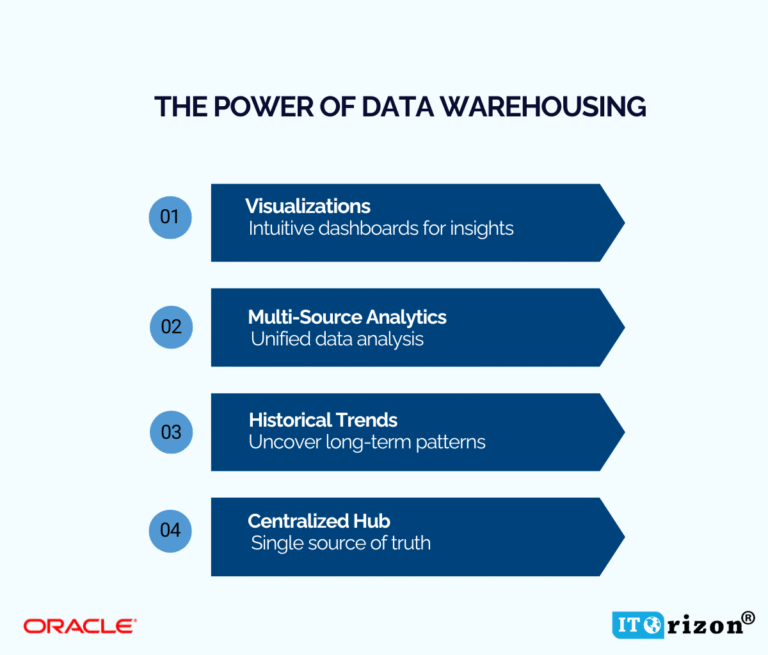
A modern Oracle cloud data warehousing solves these challenges by acting as the centralized hub—a unified source that ingests data from all systems. It provides the stable, historical foundation needed for multi-source analytics, advanced visualizations, and the AI/ML models that will define the future of supply chain management.
The Breakthrough Architecture: Unifying WMS, ERP and OTM
The Oracle cloud warehousing solution is an integrated architecture where data flows seamlessly between your core systems. The blueprint is clear: Oracle Cloud WMS, Oracle ERP Cloud, and Oracle Transportation Management (OTM) all feed data into a central repository like Oracle Autonomous Data Warehouse (ADW). On top of this unified data sits Oracle Analytics Cloud (OAC), a powerful tool for generating the dashboards and insights that drive intelligent action.
This integration unlocks specific, high-value benefits:
Value Unlocked by ERP Integration:
- Financial Reconciliation: Match physical inventory movements from WMS with financial transactions in your ERP to achieve precise cost accounting and instantly identify discrepancies.
- Purchase Order Optimization: Analyze supplier performance, lead times, and quality metrics to make smarter, data-driven purchasing decisions.
- True Cost-to-Serve Analysis: Get a clear answer by combining labor and operational data from WMS with financial data from ERP.
Value Unlocked by OTM Integration:
- End-to-End Shipment Visibility: Track goods from the moment they are picked in the warehouse to the final customer’s delivery, creating a single, unbroken chain of custody.
- Carrier Performance Analysis: Evaluate carriers on a holistic set of metrics, including cost, service quality, damage rates, and on-time performance, to optimize your logistics network.
- Freight Cost Optimization: Analyze shipping patterns to identify consolidation opportunities, select the most efficient shipping methods, and reduce freight spend.
The Bottom Line: Quantifiable ROI from a Unified View
This integrated strategy offers real-time visibility, hard, measurable returns that resonate in the boardroom. By aligning operational data with financial and logistical outcomes, organizations consistently achieve a significant ROI.
- Inventory Optimization: Organizations typically see 10-20% reduction in inventory carrying costs through better demand forecasting and inventory positioning. For a company with $50 million in inventory, this represents $5-10 million in cash flow improvement.
- Labor Productivity: Integrated analytics typically drive 15-25% improvement in warehouse labour productivity through better task prioritization, performance management, and process optimization.
- Order Fulfillment Accuracy: Data-driven process improvements often result in 2-3% improvement in order accuracy, reducing returns, expedited shipping costs, and customer service expenses.
- Transportation Optimization: Integration with OTM and comprehensive analytics typically yield 8-15% reduction in transportation costs through better carrier selection, route optimization, and consolidation opportunities
By connecting these dots, you can present quantifiable, traceable data that shows exactly how warehouse performance impacts the balance sheet. This is what transforms the warehouse from a cost center into a strategic growth lever.
Your Roadmap to Oracle Cloud WMS Enterprise Intelligence
Embarking on Oracle cloud warehousing is a strategic initiative that requires a clear plan. Success hinges on a few key considerations:
- Adopt a Phased Approach: Begin with the core WMS functionality to stabilize operations, then layer in data warehousing and integration capabilities.
- Prioritize Change Management: User adoption is critical. Budget for comprehensive training, process documentation, and dedicated change management support.
- Establish Strong Data Governance: Define clear data ownership, quality standards, and governance processes from the very beginning to ensure your insights are built on a foundation of trust.
Ready to begin? Here is a practical 3-step plan to build momentum:
- Assess Current Reporting Gaps: Identify the critical questions your business can’t answer today. Where are your blind spots
- Identify Key KPIs: Define the success metrics that matter not just within the warehouse, but across your WMS, ERP, and OTM systems.
- Pilot the Integration: Start with a single facility or line of business. A successful pilot is the fastest way to prove the concept and demonstrate undeniable value to the organization.
Conclusion: What's Next?
A strategic development from a siloed WMS to a fully integrated supply chain intelligence hub is a transformational success. It marks the critical shift from reactive firefighting to a predictive, data-driven strategy that builds resilience and a lasting competitive advantage.
If you are ready to take the first step, our team of Oracle Cloud WMS experts can help you assess your needs and design a solution uniquely composed for your business requirements. Contact us for your WMS business consultation.
ITOrizon Inc., a global end-to-end IT supply chain ecosystem service leader based in Atlanta, with offshore locations in India and Dubai, has been helping clients ensure success for more than 10 years. We maximize the value of existing ecosystem investments while outpacing the competition with a human-first service delivery client experience. Industry analysts such as Gartner, ISG, and ARC Advisory have recognized us for our high-performance services team, built to scale and delivering strategic advisory, implementation/integration, digital transformation, and managed support services.