Thought Leadership
How to Turn Gartner’s WMS Report Into a Buying Decision
From Quadrant to Shortlist:
Every year, Gartner publishes its Magic Quadrant for Warehouse Management Systems. The Leaders get their press releases out, procurement forwards the report to the steering committee, and a shortlist starts taking shape.
It is easy to understand why. WMS is a major investment, and a well-known analyst ranking gives everyone something concrete to point to.
But there is a problem with starting the decision there.
The quadrant can tell you a lot about the vendors. It cannot tell you whether you are buying the right system for the warehouse you actually operate. It also cannot tell you whether your organization is ready to implement what you are buying.
Those two questions will matter a lot more than where a logo sits on a chart.
The WMS market has matured. Core capabilities such as receiving, putaway, wave planning and cycle counting have become table stakes across the major platforms. They still matter, of course, but they are no longer where most buyers will find meaningful differentiation. The decision has moved elsewhere.
Before comparing vendors, I would ask four questions:
- Will this platform still receive serious investment ten years from now?
- What will this really cost over a fifteen-year life, rather than the three-year horizon used in the business case?
- How quickly can we implement it in our environment?
- And perhaps most importantly: how complex is our operation really?
That last question is where many WMS decisions start going wrong.
Start with the warehouse you have
Organizations routinely overestimate their operational complexity.
It is understandable. An RFP naturally describes the warehouse you may want five years from now. Every business has future growth plans, new channels, automation projects and new requirements.
But there is a difference between planning for future growth and buying software for complexity you do not actually have.
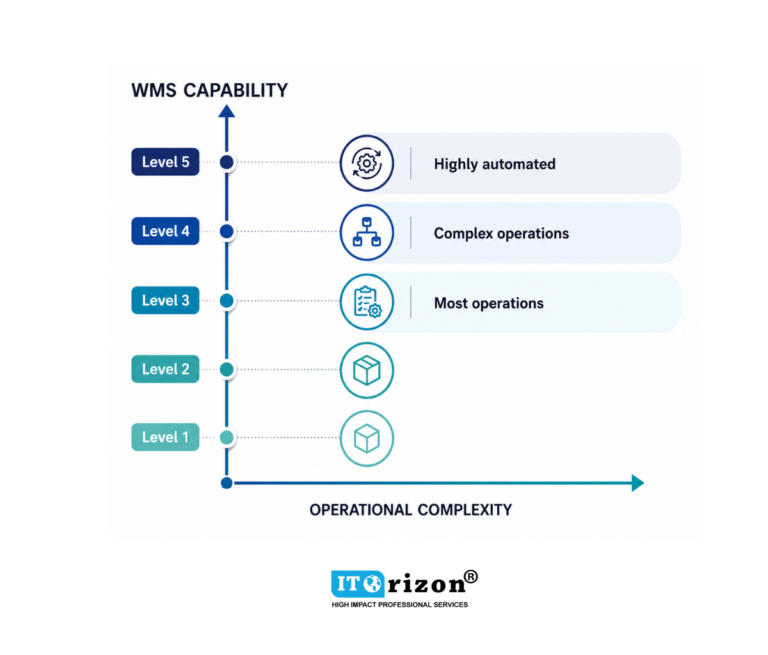
Gartner’s data indicates that most global warehouse operations are at Level 3 complexity or below. That matters because the requirements, implementation effort and cost can change significantly as complexity increases.
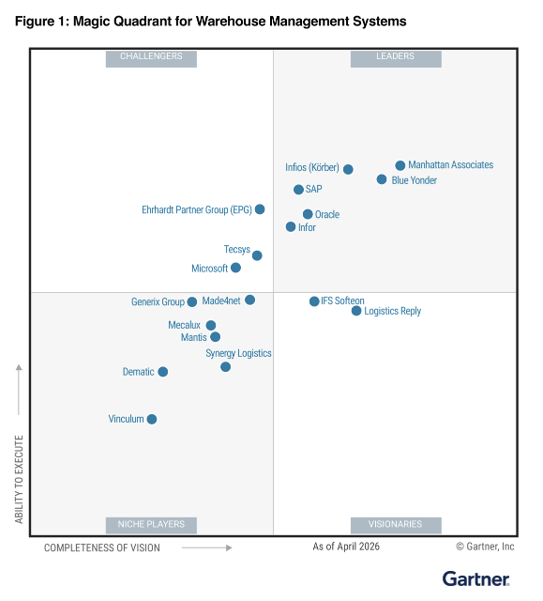
Manhattan’s strong Critical Capabilities position for advanced operations is meaningful. So is Oracle’s long track record as a Leader and its unified cloud platform.
But those advantages matter most when they match the operation.
If your warehouse does not need Level 4 or Level 5 capabilities, don’t build an RFP around Level 5 because it sounds safer.
Build the requirements around the warehouse you actually run.
Otherwise, you can end up paying for complexity before you have even created it.
Don't let the shortlist make the decision for you
The major vendors have all earned their positions in the market. The question isn’t whether they are good products. The question is whether their particular strengths match your situation.
SAP deserves serious consideration when S/4HANA is already central to the organization. Integration can be a significant advantage. But that should not automatically make SAP the WMS choice. Compare it with dedicated WMS platforms on functionality and total cost. If it is on the shortlist mainly because an ERP renewal is already happening, be honest about that.
Manhattan has real strength in advanced warehouse operations. But Manhattan Active is SaaS-only and runs on a continuous release model. For organizations moving from WMOS or PkMS, that is more than a technology decision. It changes how IT, QA and operations deal with releases. Before signing, ask what a normal release cycle will actually require from your regression testing and change-management teams.
Oracle has the advantage of a long history as a Leader and a unified cloud platform. But buyers coming from legacy Oracle WMS need to understand exactly what they are moving to. Oracle’s cloud WMS has its roots in the LogFire acquisition, which is a different lineage from the older on-premise Oracle warehouse products. If Oracle is already your ERP or NetSuite relationship, make sure the WMS is winning on its own merits rather than simply coming along with the broader relationship.
Blue Yonder has an eighteen-year Leader track record and genuine depth in planning and forecasting. But its product history includes the JDA lineage and Panasonic’s subsequent acquisition. For a buyer, the practical question is less about the corporate history and more about the architecture you are actually buying. Which generation of the platform will you be running, and what does the long-term investment plan look like for WMS specifically?
Infios, formerly Körber Supply Chain Software, is another example where the product lineage matters. The business rebranded in 2025 after a change in ownership, while the WMS portfolio itself has been assembled over several acquisitions. If it is on your shortlist, ask which underlying product you are actually buying and what that means for the roadmap and support organization over the next decade.
Made4net has a consistent record in the market and can be particularly interesting for mid-market and 3PL operations that don’t want Tier-1 pricing or complexity. For larger, multinational deployments, I would spend more time validating implementation capacity and global support coverage. Don’t assume either way. Ask the reference customers.
Tecsys has a strong reputation in healthcare distribution and a long history in the market. But if your operation is moving into Level 4 or 5 complexity—with dense automation, large-scale real-time slotting or complex omnichannel and international requirements—validate the fit with a customer operating at that level.
The point is not that one of these vendors is right and another is wrong.
It is that a Magic Quadrant position should start the diligence, not finish it.
A legacy WMS makes the decision much harder
There is another group of buyers who should approach the decision differently: organizations still running older Manhattan or Oracle environments.
For them, the question isn’t simply, “Which WMS should we buy?”
It is:
How much of what we have built over the last fifteen years actually needs to survive the move to cloud?
That is a very different question.
A mature WMS is rarely just a piece of software anymore. It contains years of customizations, integrations, workflows and operational habits. People have built processes around it. Other systems have been connected to it. The warehouse itself may have evolved around what the system can and cannot do.
That is why a legacy-to-cloud migration should not be treated like a normal version upgrade.
More than 85% of new WMS deals are now cloud, and both Manhattan Active and Oracle’s unified cloud platform are designed around modern, extensible, API-first architectures. That is important.
But architecture alone doesn’t make a migration easy.
The difficult part is moving the business logic, integrations, workflows and operational knowledge that accumulated around the old system.
The technology may be new.
The business is not.
AI is easy to demonstrate. Adoption is harder.
Every major WMS vendor is now talking about agentic AI.
Some of the capabilities are real. Manhattan’s autonomous workflow agents and Oracle’s AI-driven dynamic slotting are examples of capabilities that have moved beyond a concept slide and into production.
That deserves attention.
But there is a distinction I would keep in mind throughout the evaluation:
Shipped and adopted are not the same thing.
An AI capability can be live in the software and still be nowhere near ready to make autonomous decisions on your warehouse floor.
The difficult part isn’t always the code. It is trust, process change, governance and adoption.
So ask the vendor for a live customer reference—not a demo—where the capability is being used in an operation that looks like yours.
And budget for the adoption work.
AI isn’t something you switch on at go-live and forget about.
The decision that actually matters
The WMS market is crowded, but the core functionality across the major platforms is increasingly comparable.
That doesn’t make the decision easy. It changes what you need to pay attention to.
The first decision is not which vendor belongs on page one of your RFP.
It is whether you understand your own operation well enough to write the right RFP in the first place.
Get the complexity assessment wrong, and you can choose the wrong level of technology.
Ignore your legacy customizations, and a cloud migration can become a much larger re-engineering project than expected.
Treat AI as a feature rather than a change program, and a capability that looked impressive in the demo may never become useful on the floor.
And finally, don’t confuse vendor capability with implementation capability. The software can be excellent and the project can still fail.
That is why I would look at the WMS decision in this order:
Understand the operation.
Understand the complexity.
Understand what has to survive the migration.
Then compare the vendors.
The vendor matters.
But the quality of the decision depends first on how honestly you understand the business you are asking that vendor to support.
Get that part right, and the shortlist becomes much easier.
ITOrizon Inc., a global end-to-end IT supply chain ecosystem service leader based in Atlanta, with offshore locations in India and UAE, has been helping clients ensure success for more than 10 years. We maximize the value of existing ecosystem investments while outpacing the competition with a human-first service delivery client experience. Industry analysts such as Gartner, ISG, and ARC Advisory have recognized us for our high-performance services team, built to scale and delivering strategic advisory, implementation/integration, digital transformation, and managed support services.